
50A Parallellable Hot‑Swap Protection Device with Integrated 0.8 mΩ MOSFET

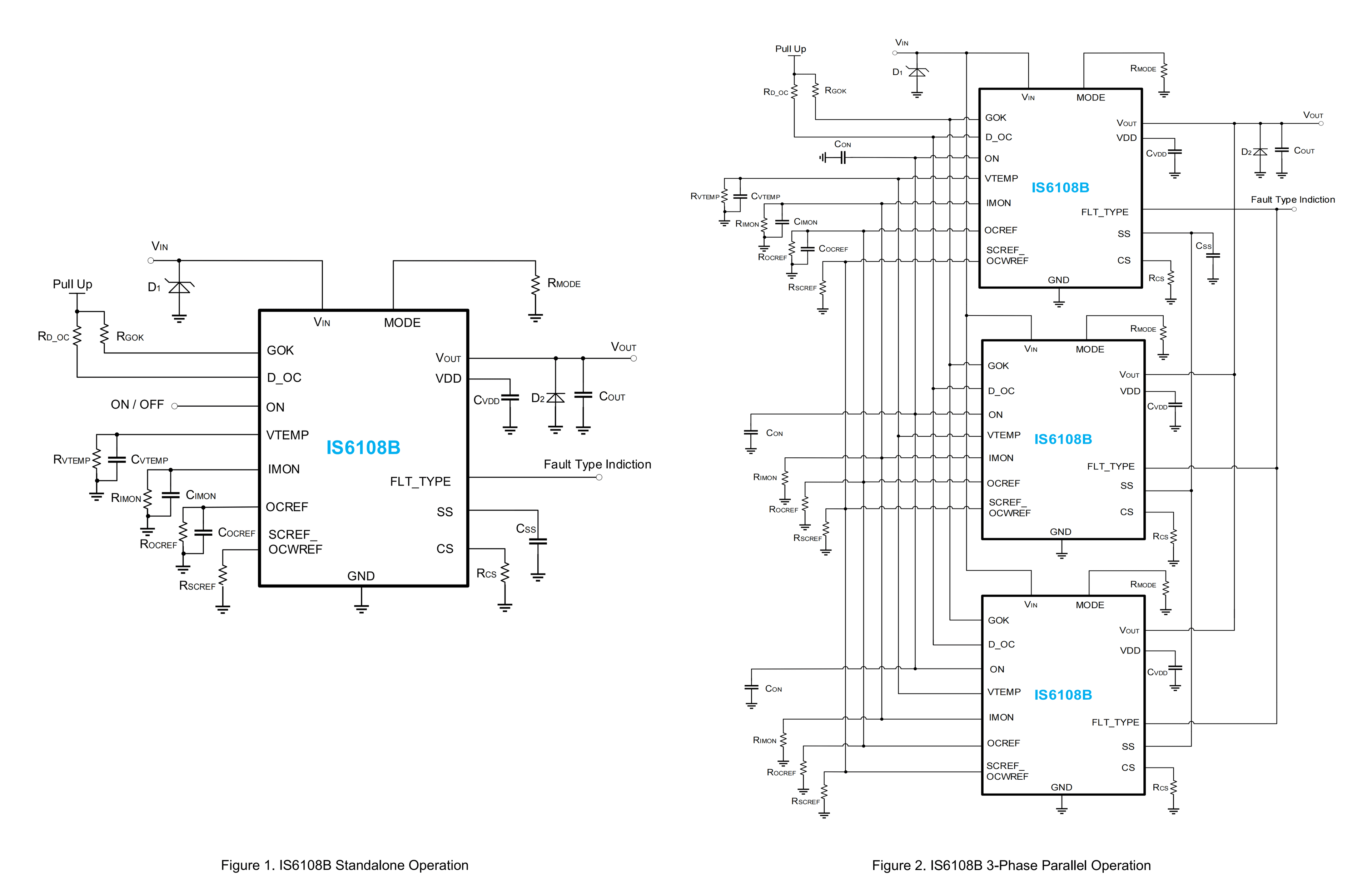
The IS6108B is designed for voltage and current fault protection. Its current‑limit threshold can be flexibly configured via a resistor connected between the OCREF pin and GND. The IC incorporates an on‑chip current‑sense circuit and provides an analog current‑monitoring signal. An integrated insertion delay delays power‑on start‑up to avoid voltage glitches upon hot‑plugging. Once the insertion delay expires, VOUT enters the soft‑start phase, effectively preventing over‑voltage breakdown of downstream components caused by unstable voltages at plug‑in. For fast high‑current load events at the output, the IS6108B triggers SCP (short‑circuit protection) instantly, turning off the FET within 200 ns. The IS6108B supplies system‑level fault‑indicator (GOK) and fault‑type (FLT_TYPE) signals to facilitate system status monitoring and fault diagnosis. Furthermore, it supports multi‑device paralleling for higher‑current applications. Active current balancing among devices is implemented during soft‑start in parallel configurations to ensure even load‑current distribution.
50A Parallellable Hot‑Swap Protection Device with Integrated 0.8 mΩ MOSFET
The IS6108B is designed for voltage and current fault protection. Its current‑limit threshold can be flexibly configured via a resistor connected between the OCREF pin and GND. The IC incorporates an on‑chip current‑sense circuit and provides an analog current‑monitoring signal. An integrated insertion delay delays power‑on start‑up to avoid voltage glitches upon hot‑plugging. Once the insertion delay expires, VOUT enters the soft‑start phase, effectively preventing over‑voltage breakdown of downstream components caused by unstable voltages at plug‑in. For fast high‑current load events at the output, the IS6108B triggers SCP (short‑circuit protection) instantly, turning off the FET within 200 ns. The IS6108B supplies system‑level fault‑indicator (GOK) and fault‑type (FLT_TYPE) signals to facilitate system status monitoring and fault diagnosis. Furthermore, it supports multi‑device paralleling for higher‑current applications. Active current balancing among devices is implemented during soft‑start in parallel configurations to ensure even load‑current distribution.